The Protestant Theological Institute of Cluj-Napoca was the venue of a less usual event on December 17, 2025: the General Visitation Committee of the Reformed Church District of Transylvania paid a visit to the Institute. During the visitation, the committee met with the leadership, faculty and students of the PTI.
Visitation of the Church District Leaders at the Protestant Theological Institute
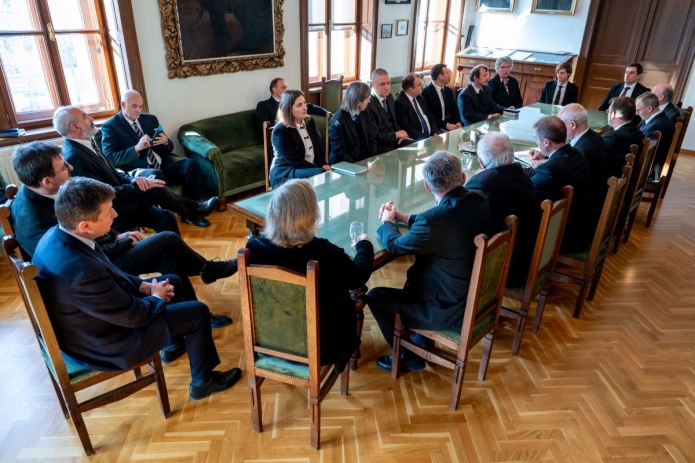
The Protestant Theological Institute of Cluj-Napoca was the venue of a less usual event on December 17, 2025: the General Visitation Committee of the Reformed Church District of Transylvania paid a visit to the Institute. During the visitation, the committee met with the leadership, faculty and students of the PTI.
The meeting was opened with a devotion by Jenő Kiss based on Isaiah 5:18–20, in which he emphasised that God has entrusted the Church with two kinds of service: the use of pure language and a radical manner of speaking that flows from God’s very being. In his own time, the prophet Isaiah publicly exposed those who called evil good and good evil. He drew attention to a danger that still threatens the church today: the profanised and corrupted use of language that lacks holiness. The compromise of language, he noted, leads inevitably to moral compromise. For this reason, God’s prophets—both in the past and today—have had to raise their voices. God demands exclusive loyalty for himself, he stressed. He expects us to entrust not only our salvation to him, but all other matters of our lives as well. This is the pure speech and the radicalism worthy of God’s being, and this is also the task of the Church and theology today.
In his greeting to the committee, Rector Sándor Kovács expressed his gratitude for the visit. He pointed out that although the visitation committee had left the Theological Institute until last among the church-supported schools, being last according to the Gospel does not necessarily mean a disadvantage. He emphasised that the training of ministers is a shared responsibility of the church and theology, and he expressed his appreciation to the church district—and to the other supporting church districts as well—for taking on this task.
As president of the General Visitation Committee, Bishop Vilmos József Kolumbán greeted the leadership. He highlighted that the year 2025 was designated as the Year of Youth in the Hungarian Reformed Church. Closely connected to the issue of youth is the matter of education. Within this framework, during the year the committee visited six church colleges, two affiliated colleges, and the two universities—the religion teacher training program of Babeș–Bolyai University and the PTI as well. Drawing on his 25 years of experience as a theological educator, he noted that he did not arrive at the Institute as a stranger; rather, his aim was for the Institute to assist the church in carrying out its tasks, through scholarship as well as through strategy. The visitation also fits into the framework of dialogue that was established in 2016 with the Transylvanian Reformed Church District during the meetings in Illyefalva (Ilieni).
The one-hour joint discussion addressed the Institute’s educational and formative matters, such as the question of launching a doctoral school, the issue of ministerial training in the Carpathian Basin, the assessment of theological students’ suitability for ministry, as well as the Church’s current social challenges and other difficulties.
The student body of the PTI welcomed the episcopal visitation committee of the Transylvanian Reformed Church District in the ceremonial hall with the Aaronic blessing. By way of introduction, the bishop shared a few curiosities related to the ceremonial hall and the council chamber. He explained that in earlier times deceased professors were laid out in state in the ceremonial hall, and that in the council chamber ideas and initiatives were born that eventually gave rise to organizations such as the Transylvanian Christian Youth Organisation (TCYO), the Christian University Students Association (CUSA) and the Women’s Association. He drew the attention of the theological students to their important role both in TCYO and CUSA, and more broadly in student life in Cluj-Napoca. He encouraged them to spend as much time as possible in the city’s rich libraries, thereby further enriching their knowledge and culture.
During the meeting with the theological faculty, Bishop Vilmos József Kolumbán spoke about the importance of church schools and the high quality of education provided in them. The discussion also touched on the opportunities and difficulties experienced in the church’s youth ministry. Chief Notary László Szegedi remarked that a musical offering better adapted to contemporary times could open further possibilities in this ministry, and he raised the question of what opportunities might exist to implement this. He also considered it important that the Transylvanian Reformed Church District’s programs related to youth and children’s ministry become known among theological students as well. It became clear during the discussion that ministry to youth stands before us as one of the most desired yet most challenging services of the Church, a reality felt both in church work and in theological education.
At the closing worship service of the joint gathering, the sermon was again taken from the book of Isaiah. Based on Isaiah 61:10, General Director István Jakab spoke about the threefold face of joy connected to divine service, which is integral to the Christian way of life and especially to the evangelical mission. The coming of God’s anointed servant not only brought liberation but also bestowed a new identity upon us. One foundation of Christian service is the joy of redemption, which is not a secondary motif or an added extra, but the fundamental melody—not arising from circumstances, but the constant reality of the redeemed person. Although pastoral work rarely offers occasions for joy, joy in the Lord is far more significant than joy over the results of ministry. He further emphasized that joy also grants dignity, which the prophet compares to a garment of righteousness. This garment is something placed upon a person; it is not self-esteem or rank, but a gift—honor and grace received from another. Finally, joy is also adornment, ornament, and beauty—not only legal, but aesthetic as well. It beautifies the children of God. The church’s most beautiful garment is not its institutions, but Christ himself. And although clothing reveals little about character, it does reveal office. Therefore, Christ’s servants today must wear this garment with joy and allow God to shape it to us.
Following the worship service, the visitation continued at the residence hall in the form of an informal table fellowship. Alongside the members of the General Visitation Committee, the Institute’s staff were also present, and in this Advent community, following a now traditional format, they together brought the year 2025 to a close.